In short
- The fair is won before the stand opens: choosing the right event and filling your agenda with a pre-show campaign makes the difference.
- Visiting a fair before exhibiting is the cheapest way to check whether your buyers are actually there.
- Every contact should leave the stand qualified and recorded, with notes and a next step, not as a loose business card.
- Following up within a week, from the CRM, turns conversations into opportunities.
- Measure meetings, opportunities and cost per opportunity; in Spain, ICEX, ACCIÓ and some Chambers of Commerce support participation depending on each call.
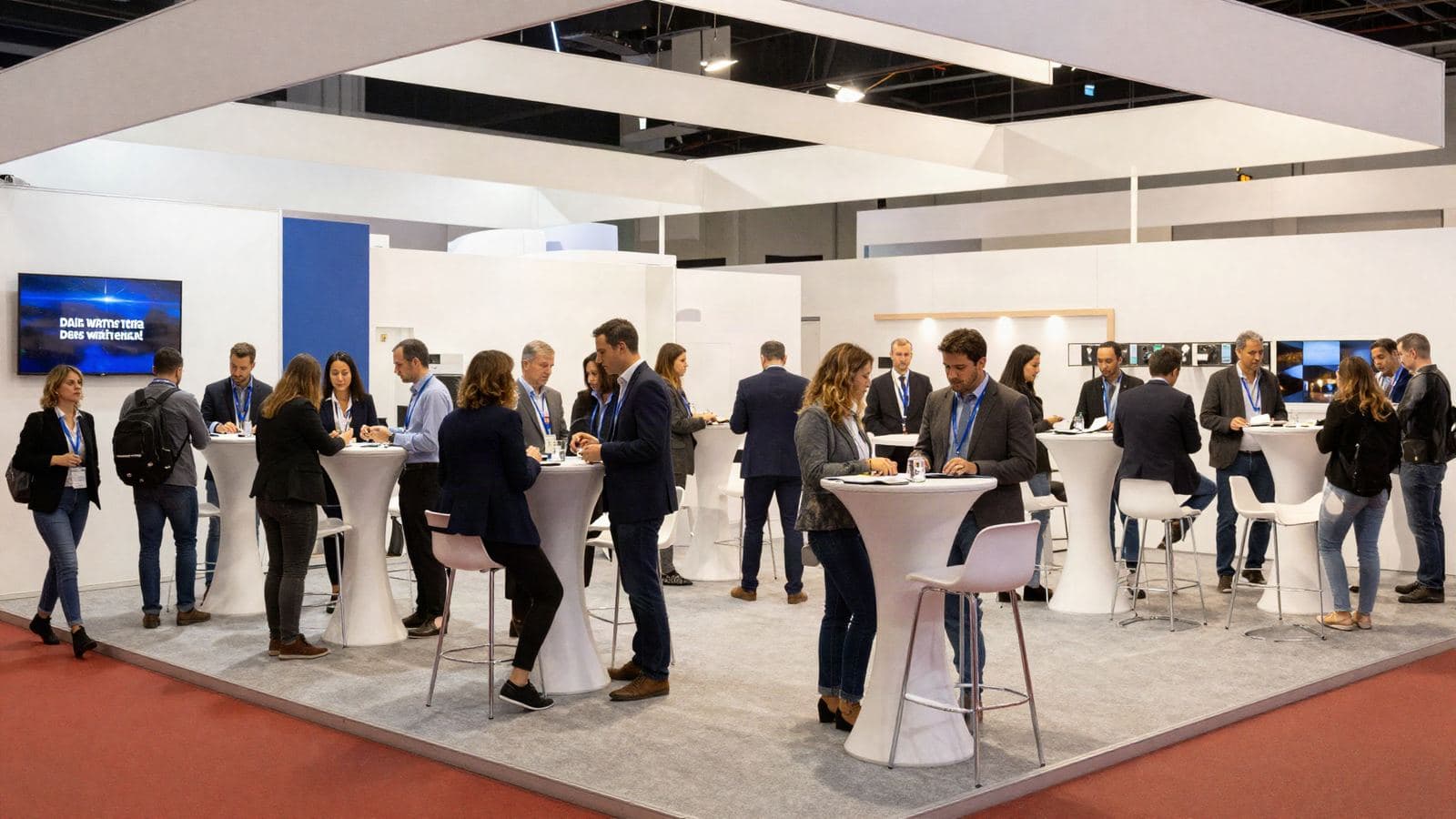
An international trade fair packs buyers, distributors and importers who have set time aside to find suppliers into three or four days. Done well, it is the fastest way to open a market. Poorly prepared, it is a bill for a stand, flights and hotels that comes back with a box of business cards. At Vycte we have taken part in more than 300 international trade fairs over more than 30 years, and this guide sets out what separates a profitable fair from an expensive one.
What an international trade fair is for if you want to export
International trade fairs for exporters serve three purposes: meeting buyers face to face, seeing what competitors are doing and validating price and product in a new market. In industrial and food sectors, many distributor relationships start at a stand and are closed weeks later.
But a fair does not replace a sales strategy. It works when it is part of a plan: a market prioritised with data, a defined partner profile (read how to find international distributors) and a system to follow up every contact afterwards.
How to choose the right international trade fair
The biggest fair is not always the best. What matters is that your buyers are there and come to buy. Before booking space, weigh up these criteria:
- Visitor profile: ask the organiser for last edition's breakdown by country, sector and job title. Look for buyers, importers and distributors, not just the general public.
- Real reach: there are global fairs and regional fairs. A well-chosen regional fair can give you more useful meetings in your target market than the big global event.
- Exhibitors: if your competitors and complementary manufacturers are there, buyers will come too.
- Timing in the buying cycle: check whether the fair coincides with the time your sector finalises ranges or plans the season.
- Total cost: add up space, stand, shipping samples, travel, accommodation and team hours, not just the price per square metre.
Public support for international trade fairs
There is funding for international trade fairs for Spanish companies, although it changes with each call. As of October 2026, ICEX organises official pavilions under Spain's common image and supports group participation in fairs, usually convened by sector associations. In Catalonia, ACCIÓ has an international promotion grant line that can cover taking part in fairs. Some Chambers of Commerce also organise fair participation and trade missions with financial support.
Requirements, eligible costs and deadlines depend on each call, so check the current one before committing. You will find an overview of programmes in our guide to internationalisation grants and in our grants service.
How to prepare for an international trade fair: step-by-step timeline
Preparation starts long before the stand is built. This is the timeline we follow with our clients:
| When | What to do | Expected result |
|---|---|---|
| 3 months before | Set goals (meetings, opportunities, markets), budget, team and samples; book travel | Fair plan with measurable goals |
| 6-8 weeks before | Identify exhibitors and visitor profiles that match your ideal customer and build the contact list | Verified list of accounts and people to contact |
| 4-6 weeks before | Launch the pre-show campaign in the buyer's language; prepare materials and translations | First meetings booked at the stand |
| Final week | Confirm meetings, prepare a brief on each account, load the list into the CRM and split the team's agenda | Agenda closed and team ready |
| During the fair | Hold meetings, qualify walk-in visitors and record every contact with notes on the spot | Qualified contacts with a next step |
| Afterwards (within 1 week) | Send personalised follow-ups, create opportunities in the CRM and schedule calls | Open opportunities in the pipeline |
Pre-show prospecting: arrive with a full agenda
The costliest mistake is waiting for the buyer to walk past your stand. Pre-show prospecting means contacting the visitors and exhibitors who match your ideal customer in advance and proposing a specific meeting: day, time and reason. It is the most reliable way to win customers at trade fairs.
The campaign is built like any B2B prospecting campaign: a verified list, messages in the buyer's language, an email and LinkedIn sequence and a well-configured sending infrastructure. We will not repeat it here: you have the full method, including the sequence and the legal framework, in our guide to international B2B prospecting campaigns.
- A specific proposal: "20 minutes at our stand on Tuesday at 11" works better than "drop by and see us".
- A reason to come: a new product, a sample, terms for distributors in their country or a case similar to theirs.
- Exhibitors too: complementary manufacturers and exhibiting distributors are valuable contacts and have emptier agendas than visitors.
Stand, materials and team in the buyer's language
The stand has one job: to let the right visitor understand in three seconds what you do and why it matters to them. Less text, a clear message and visible product. The rest happens in conversation.
- Main message in English and in the host country's language: what you make, for whom and what sets you apart.
- Data sheets and catalogue in your markets' languages, with prices or terms ready to send afterwards, not to leave on the table.
- Samples designed for demonstration and a small stock for buyers who show real interest.
- A team with languages: at least one person fluent in the market's language and another who knows the product inside out. At Vycte we work in six languages, including French, Chinese and Arabic.
- Clear roles: who handles booked meetings, who engages walk-in visitors and who walks the halls to visit exhibitors.
During the fair: qualify and record every contact
A business card with no context is useless a week later. Every conversation should end with three things recorded: who they are (company, role, country), what they need (product, volume, timing) and what the next step is (send an offer, a sample, a call).
To qualify quickly, use four questions: what type of company it is (distributor, importer, manufacturer, end customer), what they buy today and from whom, what volume they handle and who decides. Classify each contact as hot, warm or cold before they leave the stand.
To record contacts without losing time, Exporta.ai lets you capture leads with a QR code, a photo of the business card (OCR) and voice notes, all linked to the contact. At the end of each day, review contacts with the team and set follow-up priorities.
Following up trade fair leads: the week that decides the outcome
Following up trade fair leads is where most of the value is lost. The buyer has spoken to dozens of suppliers; if your message arrives three weeks later, they no longer remember you. Send the first follow-up within a week, and to hot contacts within the first two or three days.
- Load contacts into the CRM with the fair tag, their classification and notes. With Clientify or whatever integration you use, each contact gets an owner and a dated task; we explain it in our guide to CRM with Clientify and WhatsApp.
- Send a personalised message: recall the conversation, attach what you promised (offer, data sheet, price) and propose the next step.
- Create the opportunity for contacts with a need, volume and timeframe, with an estimated value.
- Schedule a short sequence for warm contacts and periodic communication for cold ones.
- Review at 30 and 90 days which contacts have moved forward and which have gone cold.
It is what we have seen at more than 300 fairs: the outcome depends less on the stand and more on the work before and after. If you lack the team to cover it, an outsourced export department can handle preparation, agenda and follow-up.
Metrics: how to tell whether the fair was worth it
The number of business cards measures nothing. Set goals three months ahead and compare them with these indicators afterwards:
| Metric | How it is calculated | What it tells you |
|---|---|---|
| Meetings booked | Appointments confirmed before the fair | Measures the effectiveness of the pre-show campaign |
| Meetings held | Appointments that took place plus qualified walk-ins | Measures how well the stand was really used |
| Qualified contacts | Hot and warm contacts with a next step | Separates real interest from footfall |
| Opportunities | Contacts with a need, volume and timeframe created in the CRM | What feeds the pipeline |
| Cost per opportunity | Total cost of the fair divided by opportunities | Compares fairs with each other and with other channels |
| Orders at 6-12 months | Sales attributed to fair contacts | The final return, which arrives later |
With the fair tag in the CRM, these figures come out on their own. You can then decide with data whether to return, switch fairs or invest that budget in direct prospecting.
Common mistakes at international trade fairs
- Choosing a fair for its reputation rather than its visitor profile.
- Turning up without booked meetings and relying on aisle traffic.
- Materials only in your own language or with unreviewed machine translations.
- A stand full of text that nobody reads, with no visible product.
- Not recording contacts on the spot and rebuilding them from memory at the hotel.
- Late or generic follow-up, the same email to everyone three weeks later.
- Not measuring: without goals or cost per opportunity, you will not know whether to go back.
Frequently asked questions
How far in advance should you prepare for an international trade fair?
Ideally start about three months ahead to set goals, budget and samples. The contact list is built six to eight weeks before, and the pre-show campaign goes out four to six weeks before the event. The final week is for confirming meetings and preparing a brief on each account.
How do I get meetings at a trade fair before it starts?
With a pre-show prospecting campaign: identify the visitors and exhibitors who match your ideal customer, write to them in their language by email and LinkedIn and propose a specific meeting at your stand, with a day, a time and a reason to come. Confirm the meetings in the final week and send your stand location.
Is there funding for taking part in international trade fairs?
In Spain, yes, depending on each call. ICEX organises official pavilions and supports group participation in fairs, usually through sector associations. In Catalonia, ACCIÓ has an international promotion grant line that can cover fairs, and some Chambers of Commerce organise subsidised participation. Check the requirements, eligible costs and deadlines of the current call.
How soon should I follow up trade fair leads?
Send the first follow-up within a week, and to the most interested contacts within the first two or three days. Buyers talk to many suppliers at a fair and forget quickly. A personalised message that recalls the conversation and proposes a next step converts far better than a generic email weeks later.
Is it worth exhibiting, or is it better to visit the fair?
If you do not know the fair, visit it first: for the cost of a trip you can check whether your buyers are there, and you can book meetings as a visitor with a prior campaign. Exhibiting makes sense once the fair has proven it attracts your ideal customer and you have the capacity to prepare the agenda and follow-up.