In short
- A standard ERP handles accounting, invoicing, taxes and CRM well: there is no point rebuilding that from scratch.
- Custom software pays off for the process that sets you apart, or that no product covers without workarounds and parallel spreadsheets.
- The usual architecture combines Holded and Clientify as the base with your own application, for example on Supabase and Vercel, connected via API or Make.
- AI speeds up development, but it does not replace design, security, testing or maintenance.
- Insist that the code, the domain and the service accounts are in your company's name from day one.
What custom management software is (and what it is not)
Custom management software is an application designed around a specific process in your company: how you take bookings, schedule, produce, quote or serve customers. You do not bend the way you work to fit the software; the software is built for the way you work.
It does not mean rebuilding accounting, invoicing or taxes from scratch. Those pieces are already solved by products like Holded, which are also updated when regulations change, as happened with VeriFactu in Spain. Paying to reinvent them is often the first mistake in many projects.
In practice, when an SME asks us for bespoke management software, it almost always needs three things: a well-configured standard ERP, a CRM and its own layer that covers what neither of them does. We explain this in detail in our guide to digitalising SMEs with Holded, Clientify and Make.
Custom ERP or standard ERP: how to decide
The useful question is not «custom or standard» but which part of your operations deserves which. This table summarises the criteria we use in our diagnosis sessions.
| Criterion | Standard ERP (Holded, Clientify) | Custom software |
|---|---|---|
| Type of process | Common to many companies: invoicing, bookkeeping, collections | Specific to your business or what sets you apart |
| Regulations | The vendor keeps it up to date | You maintain it if you include it |
| Go-live | Fast: it is configured | Needs design, development and testing |
| Cost | Subscription per user or plan | Initial project plus ongoing maintenance |
| Flexibility | Limited to what configuration allows | Total, within what is designed |
| Dependency | On the vendor and its roadmap | On the team that maintains the code |
| When to choose it | Always for standard processes | When the standard forces workarounds or spreadsheets |
A clear sign you need something custom: your team keeps a parallel «master» spreadsheet because the ERP does not reflect how the business really works. Another: you copy data by hand between three tools every day.
What usually works: standard for the common, custom for what is yours
The architecture we recommend most is a hybrid. Holded keeps invoicing, accounting, taxes, treasury and inventory; Clientify keeps the CRM, WhatsApp and campaigns. The custom application handles the specific process and connects to both.
- Via API: the Holded API lets you read and create contacts, products, sales documents and stock, with webhooks to react to changes. We cover it in our guide to Holded integrations.
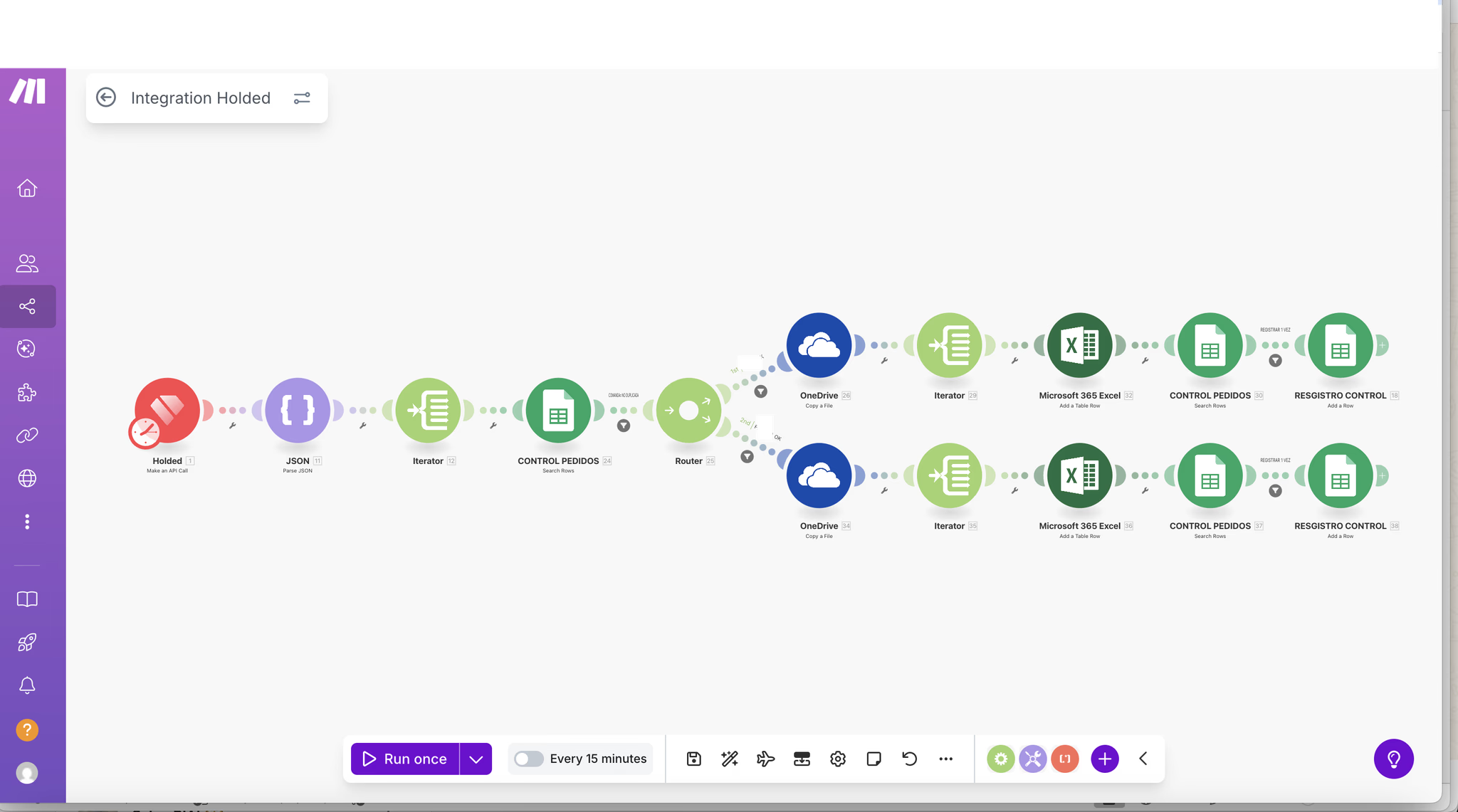
- Via Make: for flows without complex logic (alerts, calendar sync, document generation), a Make scenario is faster to build and change. See examples in our guide to Make automations.
- One source of truth per data point: prices and stock in Holded, sales data in the CRM and your own process in the custom application.
That way you do not pay to develop what already exists, the ERP vendor keeps handling tax compliance and development focuses where it creates an advantage. As a Holded Solution Partner Gold and an official Clientify partner, we design all three pieces together.
How custom software is built with AI today
Custom software with AI is not asking a chatbot for an app and publishing it. It is professional development in which tools like Cursor or Claude Code write, review and test code under the direction of a team that decides the architecture and validates every change.
AI-assisted development
AI speeds up the repetitive parts: screens, forms, queries, tests and documentation. That means working prototypes can be shown sooner and more time goes into what matters: understanding the process and testing it with real users. The time saved varies a lot by project, so be wary of anyone promising fixed deadlines without a diagnosis.
A modern, proven stack
For management applications we work with Supabase (PostgreSQL database, authentication and file storage) and Vercel to deploy the web app. Both are managed services: you do not maintain your own servers and the application scales with usage.
Security and data
- Access control by user and role, with security rules in the database itself.
- Data hosted in the EU when the project requires it, for GDPR.
- Backups, change logs and separate test and production environments.
- API keys for Holded, Clientify or other services stored as secrets, never in the code.
Code ownership and maintenance
The code, the domain and the Supabase, Vercel and Make accounts should be in your company's name. That way you can change provider without losing anything. And budget for maintenance from the start: dependency updates, changes in connected APIs and improvements that come with use.
Custom software development for SMEs: the process with Vycte
- Discovery: interviews with the people who run the process every day, a map of data and tools, and a decision on what goes to the ERP, the CRM, Make or custom development.
- Prototype: a clickable version with the key screens and sample data to validate the flow before building.
- Iterative development: short releases the team tests with real cases, prioritising what saves the most hours.
- Integrations: connections with Holded, Clientify, calendar, email or payment gateway, via API or Make.
- Training: role-based sessions so the team uses the tool and knows who to ask; training can be subsidised through FUNDAE.
- Support and evolution: bug fixing, technical maintenance and new features based on real use.
The scope of the first version is decided during discovery. We prefer a smaller application that is used from the first month over a complete project that takes a long time to reach production.
Custom management applications in production: Carvisa and Exporta.ai
The second proof is our own. Exporta.ai is the AI export platform that Vycte has designed, built and runs: it analyses markets with official trade data, finds importers and distributors, captures trade fair leads with business card OCR, includes a CRM and translates documents while keeping their format. It is available in four languages and hosts data in the EU.
Building and running our own product with real users forces us to solve the same things we ask of a client project: security, performance, integrations and continuous improvement. You can find out more on the Exporta.ai page.
Common mistakes when commissioning bespoke management software
- Rebuilding what already exists: developing your own invoicing or accounting when Holded solves it and keeps it up to date.
- Starting with the technology: choosing tools before understanding the process and whose time it saves.
- Wanting everything in version one: it stretches the project and delays the moment the team starts using it.
- No internal owner: someone in the company must validate releases and set priorities.
- Code and accounts in the provider's name: it ties you in even if the service does not suit you.
- Forgetting maintenance: unmaintained software degrades when connected APIs or dependencies change.
- Skipping training: a tool the team has not mastered ends up replaced by the usual spreadsheet.
How to fund custom development
Part of a digitalisation project may fit public grants in Spain when a call is open, such as Chambers of Commerce programmes, ACCIÓ vouchers in Catalonia or Kit Consulting. Each call defines which costs it covers, so review it before fixing the scope. We summarise the options in our guide to digitalisation grants for SMEs.
Training your team on the new tool, like Holded, Clientify, Make or applied AI training, can be subsidised through FUNDAE. Through our grants service we help you identify the funding that fits your project.
Frequently asked questions
How much does custom management software cost?
It depends on the number of processes, users and integrations, and on whether it is combined with a standard ERP or tries to replace it. Combining Holded or Clientify with a custom layer usually lowers the cost, because only the specific part is developed. On top of the initial project, budget for maintenance and cloud services. Always ask for a diagnosis before a quote.
Is a custom ERP or a standard ERP better?
For accounting, invoicing, taxes and inventory, a standard ERP like Holded is almost always better: it is cheaper, goes live sooner and the vendor keeps it compliant with regulations. Custom development pays off for the process specific to your business that the standard product cannot cover without workarounds. Most companies combine both.
Can custom software be connected to Holded?
Yes. The Holded API lets you read and create contacts, products, sales documents and stock, and its webhooks notify you when something changes. For simple flows, Make has a Holded app with ready-made modules. That way the custom application runs your specific process while Holded keeps handling invoicing and accounting.
Who owns the code of custom software?
It should belong to your company, and it is worth putting that in writing in the contract. Also ask for the repository, the domain and the cloud service accounts, such as Supabase, Vercel or Make, to be in your company's name. That way you can change provider or grow the team without depending on whoever built it.
Is software built with AI secure?
It can be, if AI is used as a tool within a professional process: architecture defined by people, review of every change, testing, role-based access control, backups and secrets kept out of the code. The risk lies in publishing generated prototypes without review. Always ask how data is protected and who maintains the application.
How long does it take to build a custom management application?
It depends on scope and integrations, which is why a serious timeline comes out of discovery, not a blind estimate. AI-assisted development makes it possible to show a clickable prototype early and deliver in phases, so the team starts using the first version before the full project is finished.